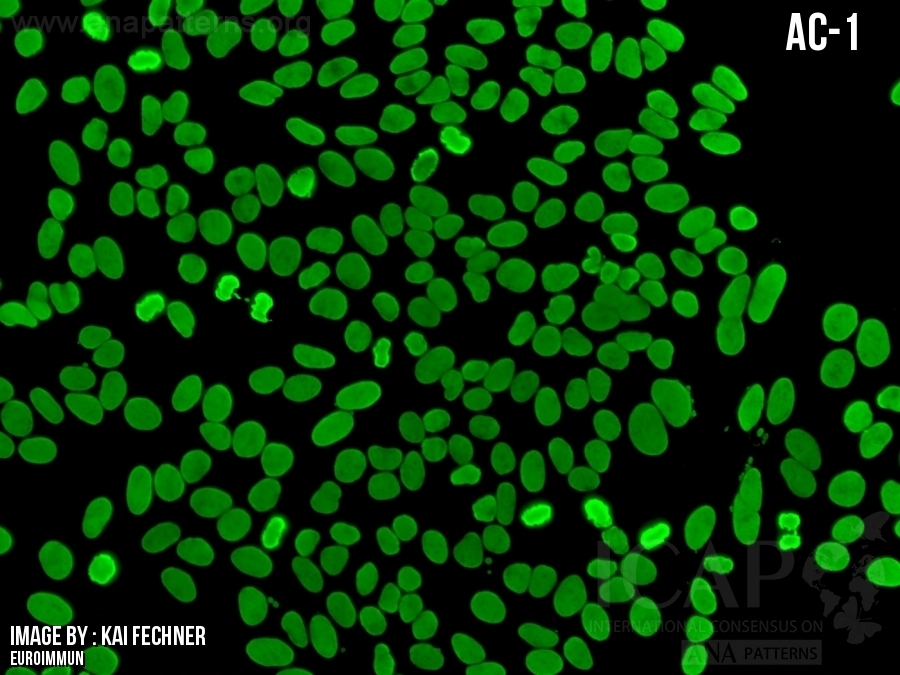
▶ AC-29模式对系统性硬化症(SSc)具有高度特异性,尤其是与弥漫性皮肤型SSc及更具侵袭性的SSc亚型相关[1-3]。
▶ 若临床怀疑SSc,建议进行抗拓扑异构酶I的后续检测;该抗体已纳入SSc的分类标准,且该抗原已包含在常规ENA谱检测项目中[3-5]。

| 简体中文 | ||
| 同义词 | Scl-70-样, Scl-86, DNA Topo I | Scl-70-like, Scl-86, DNA Topo I |
| 描述 | Topo I -样核型可能包含5种亚细胞区域的染色 [1, 2]: 1)分裂间期细胞核呈现细颗粒(AC-4)荧光。 2)有丝分裂期细胞染色体呈现细颗粒样的增强荧光。根据血清稀释度的不同,有丝分裂期的染色体可能表现为均质型荧光。 3)有丝分裂期细胞中与浓缩染色体相关的核仁组织区域(NOR)呈现强染色。这种NOR染色可能被明亮的染色体染色所掩盖,因为NORs并不总是在同一聚焦层面上(见下图)。 4)分裂间期(和有丝分裂期)的细胞胞浆有较弱的荧光染色,呈现为从细胞核向胞浆扩散的微弱的网状结构;一般而言,当血清滴定至较高稀释比例时,可以观察到相对明显的细胞质染色。 5)分裂间期细胞可呈现多种核仁染色,表现为核点型或核周型。核仁染色并不是这种核型的普遍特征。 在大多数商业化的HEp-2细胞片中已观察到包含这5种要素的复合染色模式,但是在不同的品牌中,每种要素的表现可能会有一些差异。同时检测到全部5种染色模式可能是一个挑战,尤其当只使用一种血清稀释度(如有丝分裂期染色体增强染色会掩盖NOR)或在许多半自动化体系中往往只在一个聚焦面上拍摄图像(如在分裂间期的细胞核中,NOR或胞浆染色不在同一聚焦面)。 实用建议,在HEp-2载片进行常规筛查表现为AC-29核型时传统显微镜的设置:如果在常规检查中观察到上述1)和2)的特征提示AC-29,下一步则应该在分裂期的染色体上从不同的聚焦层面寻找3)阳性的NOR染色。接下来,应该评估是否存在4)细胞浆染色及最后评估是否有5)核仁染色。在一些HEp-2载片中,核仁染色仅在载片的边缘区域可见。
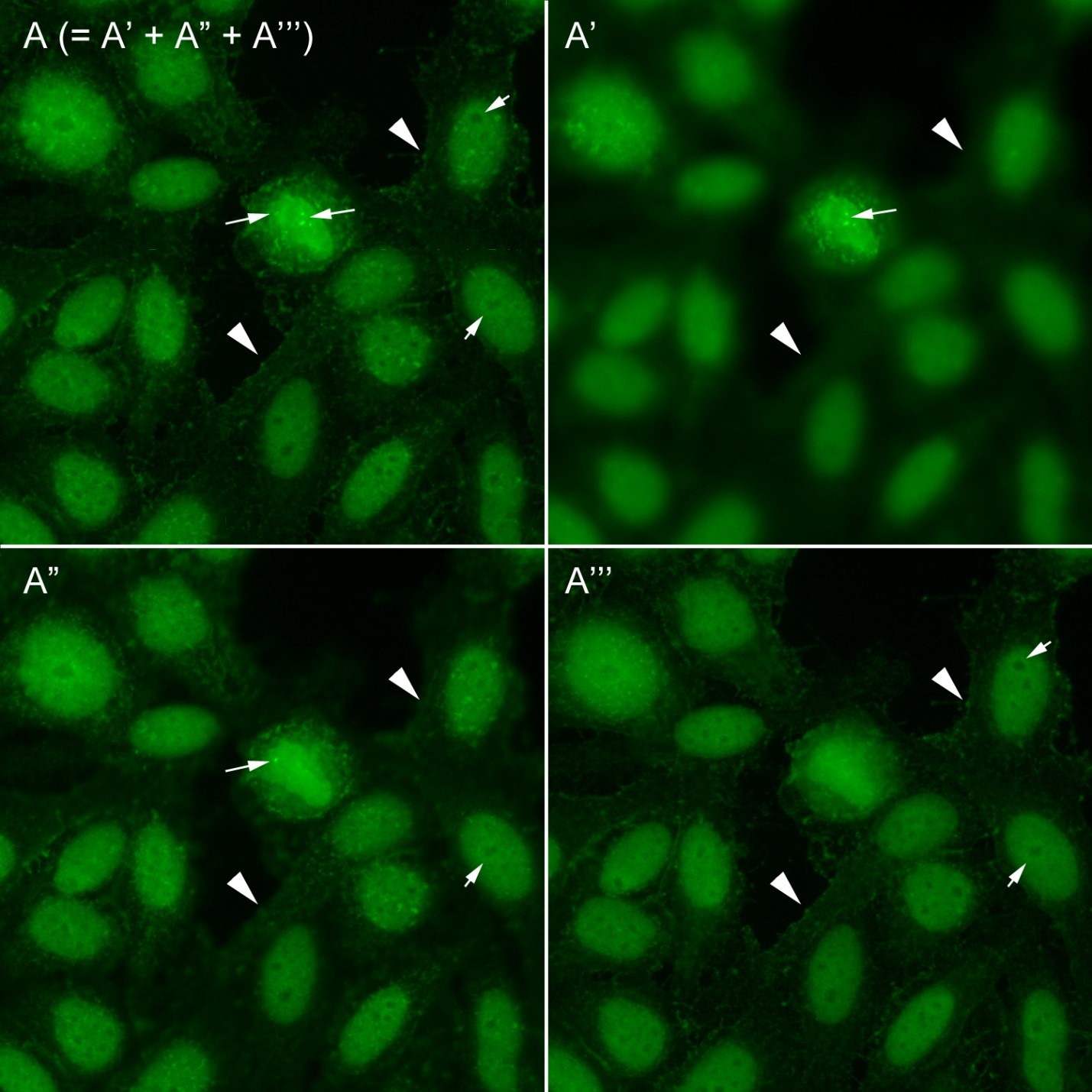
INOVA HEp-2图像,展示AC-29荧光核型,可见5哥结构区域均存在染色。图A是由其余3张子图(A'、A''、A''')的叠加图像,这3张子图代表不同的光学切面/焦平面,每个图都显示了在其他焦平面中不明显的独特染色结构。除了明显的核质和丝裂期浓缩染色质染色外,图A'显示了丝裂期细胞浓缩染色质上两个聚焦清晰的NOR(箭头);图A''显示了同一细胞中另一个聚焦清晰的NOR(箭头);A'''显示了特征性的胞质染色(箭头head)和弱的核仁周围染色(短箭头)。 |
The Topoisomerase I-like pattern is associated with staining of five subcellular regions [1, 2]: This 5-element compound staining pattern has been observed in most commercial HEp-2 cell slides, but there may be some variations in the expression of each element depending on the slide manufacturer. The detection of all 5 elements may be a challenge especially when only a single serum dilution is used (e.g. strong mitotic chromatin staining obscures NOR) or in many semi-automated systems when images are often imaged on a single focal plane (e.g. NOR or cytoplasmic staining is not in same focal plane as interphase nuclei). Practical recommendations: if the features 1 and 2 (above) are observed suggestive of AC-29, the next step should be to look for feature 3 (positive NOR staining) by focusing at different focal planes for NORs on mitotic chromatin. Next, the presence of feature 4 (cytoplasmic staining) and feature 5 (nucleolar staining) should be evaluated.
INOVA HEp-2 images illustrating the AC-29 pattern with staining in all 5 compartments. Panel A is a merged image from the other 3 panels (A', A'', A''') representing different optical sections/focal planes, each illustrating the unique stained structures not obvious in the other focal planes. In addition to the obvious nucleoplasmic and mitotic condensed chromatin staining, panel A' illustrates two bright NORs in focus (arrow) on condensed chromatin in the mitotic cell; panel A'' shows another NOR in focus (arrow) in the same cell; A''' shows characteristic cytoplasmic (arrowhead) and weak perinucleolar staining (short arrow). |
| 抗原相关性 | DNA拓扑异构酶I(topo I)样(旧称Scl-70) |
ADN topoisomérase I (topo I)-like (anciennement Scl-70) |
分类表中的AC-29。为了将单个血清正确分类为AC-29,评估与AC-29模式相关的亚细胞结构域的所有五个元素是否都至关重要?换句话说,它是否可以归类为AC-29,仅具有五种元素中的某些元素是否可以归类为AC29核型?
日期:2019年01月28日