| 简体中文 | ||
| 同义词 | 中心粒 | Centrioles |
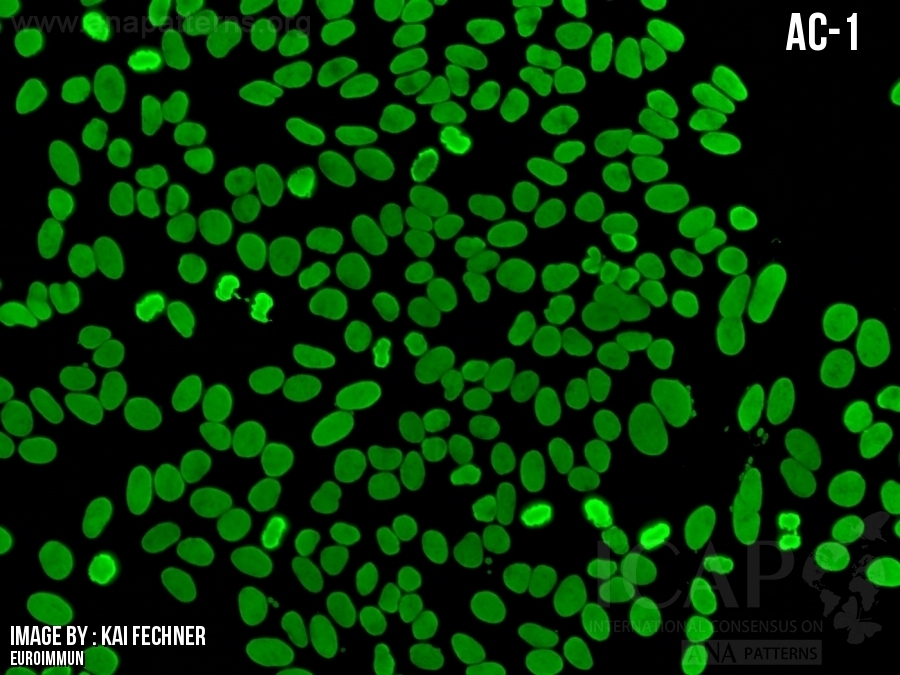
| 描述 | 在细胞质和分裂期细胞纺锤体的两极存在明显的中心粒/中心体(每个细胞1-2个) |
Distinct centrosomes/centrioles (1-2/cell) in cytoplasm and at the poles of mitotic spindle |
| 抗原相关性 | 中心粒周蛋白,ninein,Cep250,Cep110,α-烯醇化酶,γ-烯醇化酶,Mob1,PCM-1/2;这些自身抗体的特异性免疫检测试剂目前尚未商品化[1-4] |
pericentrin, ninein, Cep250, Cep110, α-enolase, γ-enolase, Mob1, PCM-1/2; specific immunoassays for these autoantibodies are currently not commercially available [1-4] |
-
▶AC-24核型对任何疾病的阳性预测价值都很低。▶在系统性自身免疫性风湿疾病谱内,AC-24核型在雷诺现象、局限型硬皮症、系统性硬化症、系统性红斑狼疮和类风湿性关节炎中或被单独检出或与其他系统性硬化症关联的抗体一起被联合检出[1, 5-7]。▶The AC-24 pattern has low positive predictive value for any disease.▶Within the spectrum of the systemic autoimmune rheumatic diseases (SARD), the AC-24 pattern is found in patients with Raynaud’s phenomenon, localized systemic sclerosis (SSc), systemic lupus erythematosus (SLE), and rheumatoid arthritis (RA), either alone or in combination with other SSc-associated antibodies [1, 5-7].
-
二级信息Second level information
-
▶可能与感染相关联;在肺炎支原体感染患儿的病例中有报道[8,9]。▶可能与恶性肿瘤相关联;在乳腺癌患者血清中经常发现与中心体的抗原反应的自身抗体[10,11]。▶据报道,在水痘感染后的小脑共济失调患儿中检出针对α-烯醇化酶、γ-烯醇化酶、Mob1、PCM-1/2和中心粒周蛋白的自身抗体;一例甲状腺功能亢进和肌肉隐痛患者与一例雷诺现象患者,两者均无系统性自身免疫性风湿疾病,但具有α-烯醇化酶和γ-烯醇化酶抗体[2, 3]。▶对于抗ninein和Cep-250抗体,血清自身抗体反应与临床诊断之间无显著相关性;此类情况在类风湿性关节炎和系统性红斑狼疮病例中有报道[4, 6]。注:大多数报道都描述了自身抗体直接与特异性抗原结合 (即抗原特异性免疫检测法),实际并未显示与AC-24核型的相关性;这些自身抗体的特异性免疫检测试剂目前尚未商品化。▶Possible association with infections; described in Mycoplasma pneumoniae infections [8, 9].▶Possible association with malignancies; autoantibodies reacting with antigens in centrosomes are frequently found in sera of patients with breast cancer [10, 11].▶Autoantibodies to α-enolase, γ-enolase, Mob1, PCM-1/2, and pericentrin have been described in children with cerebellar ataxia after varicella infection; one patient with hyperthyroidism and vague muscle pain and one patient with Raynaud’s phenomenon, both without evidence of a SARD, had antibodies to α-enolase and γ-enolase [2, 3].▶With respect to autoantibodies to ninein and Cep-250, there is no apparent correlation between serum autoantibody reactivity and the clinical diagnosis; reported in RA and SLE[4, 6].Notes: Often reports describe autoantibodies directly binding to specific antigens (i.e., antigen-specific immunoassays) and do not actually show correlations with the AC-24 pattern as such; specific immunoassays for these autoantibodies are currently not commercially available.
-
参考文献
-
1.Hamaguchi Y, Matsushita T, Hasegawa M, Ueda-Hayakawa I, Sato S, Takehara K, Fujimoto M. High incidence of pulmonary arterial hypertension in systemic sclerosis patients with anti-centriole autoantibodies. Mod Rheumatol. 2015;25:798-801.2.Fritzler MJ, Zhang M, Stinton LM, Rattner JB. Spectrum of centrosome autoantibodies in childhood varicella and post-varicella acute cerebellar ataxia. BMC Pediatr. 2003;3:11.3.Rattner JB, Martin L, Waisman DM, Johnstone SA, Fritzler MJ. Autoantibodies to the centrosome (centriole) react with determinants present in the glycolytic enzyme enolase. J Immunol. 1991;146:2341-4.4.Mack GJ, Rees J, Sandblom O, Balczon R, Fritzler MJ, Rattner JB. Autoantibodies to a group of centrosomal proteins in human autoimmune sera reactive with the centrosome. Arthritis Rheum. 1998;41:551-8.5.Takahashi T, Asano Y, Hirakawa M, Nakamura K, Saigusa R, Aozasa N, Sumida H, Fujita H, et al. Linear scleroderma with prominent multiple lymphadenopathy followed by the development of polymyositis: A case report and review of published work. J Dermatol. 2016;43:1224-7.6.Howng SL, Chou AK, Lin CC, Lin ZA, Wang CJ, Loh JK, Lieu AS, Yen JH, et al. Autoimmunity against hNinein, a human centrosomal protein, in patients with rheumatoid arthritis and systemic lupus erythematosus. Mol Med Rep. 2011;4:825-30.7.Gavanescu I, Vazquez-Abad D, McCauley J, Senécal JL, Doxsey S. Centrosome proteins: a major class of autoantigens in scleroderma. J Clin Immunol. 1999;19:166-71.8.Cimolai N, Mah D, Roland E. Anticentriolar autoantibodies in children with central nervous system manifestations of Mycoplasma pneumoniae infection. J Neurol Neurosurg Psychiatry. 1994;57:638-9.9.Saikia B, Kumar Y, Minz RW, Chhabra S. Anti-centriole antibody: An infectious or autoimmune process? Indian J Allergy Asthma Immunol. 2015;29:84-7.10.Madrid FF, Maroun MC, Olivero OA, Long M, Stark A, Grossman LI, Binder W, Dong J, et al. Autoantibodies in breast cancer sera are not epiphenomena and may participate in carcinogenesis. BMC Cancer. 2015;15:407.11.Maroun MC, Olivero O, Lipovich L, Stark A, Tait L, Bandyopadhyay S, Burke M, Zarbo R, et al. Anti-centrosome antibodies in breast cancer are the expression of autoimmunity. Immunol Res. 2014;60:339-47.
FAQ
-
有丝分裂染色模式应报告为 ANA 阳性还是阴性? 问:我应该将阳性的有丝分裂染色模式报告为 ANA 阳性还是 ANA 阴性?
对您问题的简短回答是,当检测到有丝分裂模式(AC-24 至 AC-28)时,应将其报告为 ANA 阳性(请参阅下面的参考资料)。
长答案涉及了一些考虑因素。我们知道世界不同地区的实验室对有丝分裂(甚至细胞质)染色模式的报告方式存在很大差异。一些国家将阳性的有丝分裂染色模式报告为 ANA阳性,其他国家报告为 ANA阴性。即使在一个国家内,也可能会有一些实验室将阳性的有丝分裂染色模式报告为 ANA阳性,而另一些实验室报告为 ANA阴性。因此非常重要的一点是将您报告的检测结果与您实验室所在地的情况和临床实践相互协调。尽管如此,我们建议遵循 www.anapatterns.org上的 ICAP 建议。
最重要的一点是确保您的客户可以理解您出具的结果。 ICAP 建议您避免使用 ANA 阳性或 ANA 阴性等术语。事实上,ANA这个术语已经过时,我们更倾向于抗细胞抗体(参见下面的参考文献)这个新描述。可参考实际的检测内容,即“用 HEp-2载玻片或HEp-2细胞进行的间接免疫荧光检测”作为新描述的过渡。
我们一直在努力传播这样一个概念:HEp-2 IFA的检测结果不仅仅是“阳性”或“阴性”。我们知道临床医生(和实验室)熟悉这种二分概念,但我们也了解到临床医生可以快速学习如何应用HEp-2 IFA染色模式来做出更好的临床决策。
Reference
von Mhlen et al. (2021) How to report the Antinuclear Antibodies (Anti-Cell Antibodies) test on HEp-2 cells: guidelines from the ICAP initiative. Immunol. Res., in press.
日期:2021年09月09日