简体中文

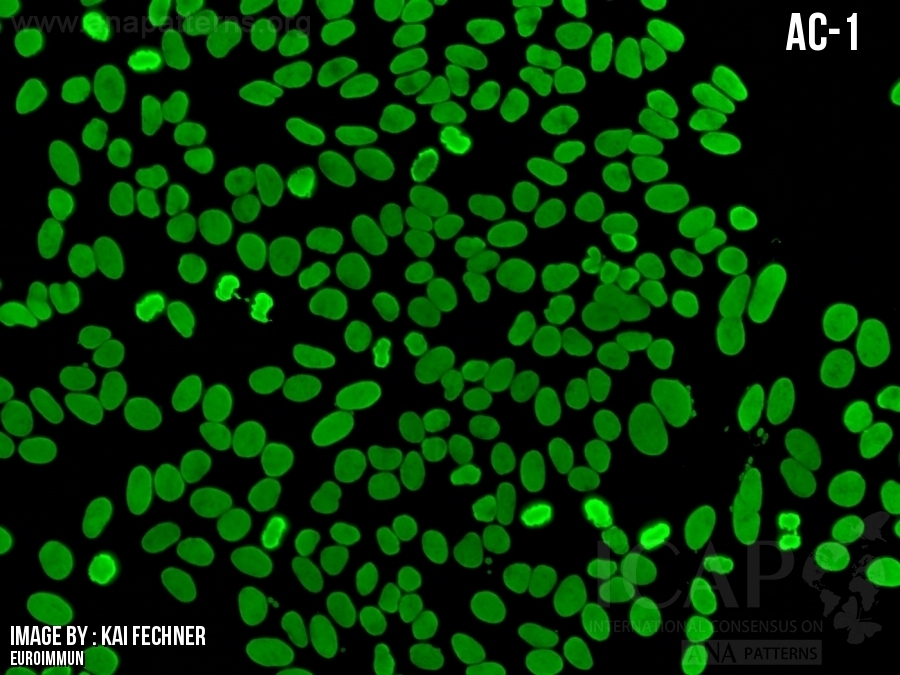
AC-20-胞浆细颗粒型

同义词 胞浆斑点型 cytoplasmic speckled
描述
胞质内散在分布大小不一的细小颗粒,背景呈均质或致密细颗粒状。
Small speckles varying in size scattered throughout the cytoplasm with a homogeneous or dense fine speckled background
抗原相关性
Jo-1/组氨酰-tRNA合成酶
Jo-1/histidyl-tRNA synthetase
  • 临床相关性

    一级信息

    关于临床相关性和缩写列表

    Clinical Relevance

    First level information

    About Clinical Relevance & List of Abbreviations
  • ▶见于抗合成酶综合征患者(特发性炎性肌病的一个亚型):其临床特征包括间质性肺病、多发性关节炎、肌炎、雷诺现象及技工手;这些临床表现可呈多种组合形式出现,或作为孤立症状单独发生,尤以间质性肺病最为常见 [1, 2]。
    ▶ 与AC-20核型相关的自身抗体已有报道见于Jo-1抗体,该抗体结合组氨酰-tRNA合成酶;由于AC-20并非Jo-1抗体所特有,建议进行Jo-1抗体的后续确认检测。该抗原已纳入多种常规ENA谱及其他结缔组织多分析物阵列检测中,同时也包含于疾病特异性免疫检测(如炎性肌病谱)中。
    ▶ Jo-1抗体已被纳入特发性炎性肌病(IIM)的分类标准 [3-5]。
    备注:AC-19与AC-20核型的区分可能取决于HEp-2底物的生产商和/或抗体浓度;Jo-1抗体在HEp-2间接免疫荧光(IFA)筛查中可能呈阴性(漏检)。
    Found in patients with the anti-synthetase syndrome (a subset of idiopathic inflammatory myopathy (IIM): interstitial lung disease, polyarthritis, myositis, Raynaud phenomenon, and mechanic’s hands; these clinical features may occur in various combinations or as an isolated manifestation, especially interstitial lung disease [1, 2].
    ▶Autoantibodies associated with the AC-20 pattern are reported for Jo-1 antibodies, which binds histidyl-tRNA synthetase; since AC-20 is not specific for Jo-1, it is recommended to perform a follow-up test for Jo-1 antibodies; the antigen is included in many routine ENA profiles and other connective tissue multianalyte arrays, as well as in disease specific immunoassays (i.e., inflammatory myopathy profile).
    ▶Jo-1 antibodies are included in the classification criteria for IIM [3-5].
    Notes: The distinction between AC-19 and -20 may depend on the HEp-2 substrate manufacturer and/or antibody concentration; antibodies to Jo-1 may be undetected in HEp-2 IFA-screening.
  • 二级信息
    Second level information
  • ▶无
    None
  • 参考文献
  • 1.Satoh M, Tanaka S, Ceribelli A, Calise SJ, Chan EKL. A Comprehensive Overview on Myositis-Specific Antibodies: New and Old Biomarkers in Idiopathic Inflammatory Myopathy. Clin Rev Allergy Immunol. 2017;52:1-19.
    2.Marie I, Hatron PY, Cherin P, Hachulla E, Diot E, Vittecoq O, Menard JF, Jouen F, et al. Functional outcome and prognostic factors in anti-Jo1 patients with antisynthetase syndrome. Arthritis Res Ther. 2013;15:R149.
    3.Fritzler MJ, Choi MY, Mahler M. The Antinuclear Antibody Test in the Diagnosis of Antisynthetase Syndrome and Other Autoimmune Myopathies. J Rheumatol. 2018;45:444-5.
    4.Lundberg IE, Tjarnlund A, Bottai M, Werth VP, Pilkington C, Visser M, Alfredsson L, Amato AA, et al. 2017 European League Against Rheumatism/American College of Rheumatology classification criteria for adult and juvenile idiopathic inflammatory myopathies and their major subgroups. Ann Rheum Dis. 2017;76:1955-64.
    5.Choi MY, Satoh M, Fritzler MJ. Update on autoantibodies and related biomarkers in autoimmune inflammatory myopathies. Curr Opin Rheumatol. 2023;35:383-94.

FAQ