简体中文

AC-5-粗颗粒型

同义词 剪接体/核基质 spliceosome/nuclear matrix
描述

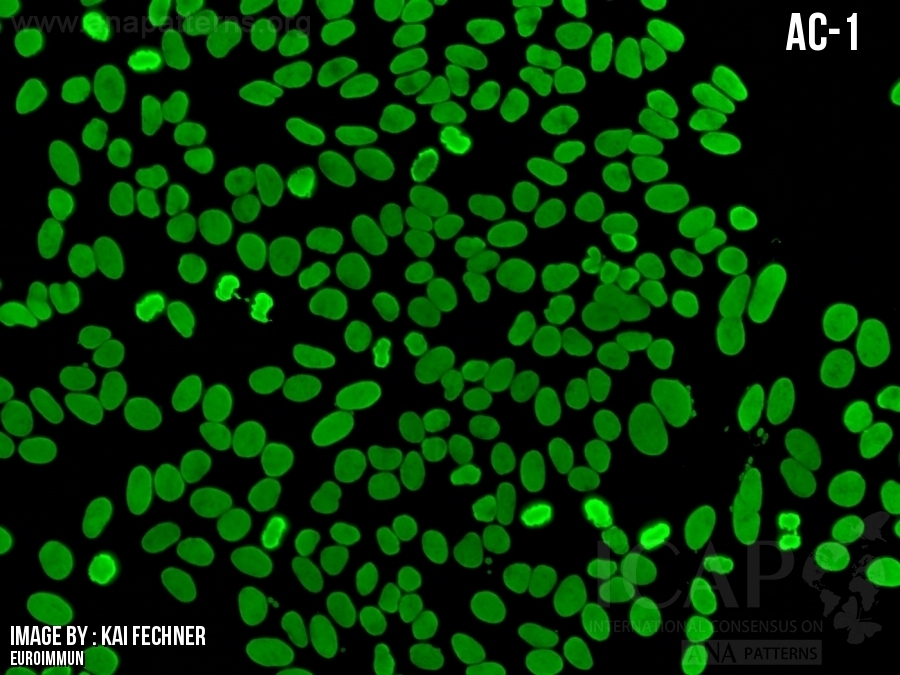
细胞核呈粗颗粒样荧光,核仁部分阳性。分裂期细胞(中期,后期和末期)浓缩染色体阴性。如:抗-Sm抗体,抗-U1RNP抗体。

Coarse speckles across all nucleoplasm. The nucleoli may be stained or not stained. Mitotic cells (metaphase, anaphase, and telophase) have the chromatin mass not stained. e.g. anti-Sm, anti-U1 RNP.
抗原相关性 hnRNP, U1RNP, Sm, RNA聚合酶III hnRNP, U1RNP, Sm, RNA polymerase III
  • 临床相关性

    一级信息

    关于临床相关性和缩写列表

    Clinical Relevance

    First level information

    About Clinical Relevance & List of Abbreviations
  • ▶存在于特定的系统性自身免疫性风湿病(SARD)中,尤其是系统性红斑狼疮(SLE)、系统性硬化症(SSc)、混合性结缔组织病(MCTD)、特发性炎性肌病(IIM)、SSc-IIM重叠综合征,以及未分化结缔组织病(UCTD),即尚未明确诊断为SARD的患者[1]。
    ▶如果临床怀疑为SLE,建议进行Sm抗体和U1RNP抗体的随访检测;这些抗原通常包含在常规可提取性核抗原(ENA)谱检测组合中;且Sm抗体已被纳入SLE的分类标准[2-5]。

    ▶如果临床怀疑为SSc、MCTD、UCTD或IIM,建议进行U1RNP抗体的随访检测;U1RNP抗体存在于一部分SSc、UCTD或IIM患者中,并且是MCTD诊断标准中的关键指标[6-9]。

    ▶在非SARD(系统性自身免疫性风湿病)个体中,AC-5核型的出现通常不与上述自身抗原相关,且抗体滴度较低。

    Present in distinct systemic autoimmune rheumatic diseases (SARD), in particular systemic lupus erythematosus (SLE), systemic sclerosis (SSc), mixed connective tissue disease (MCTD), idiopathic inflammatory myopathies (IIM), SSc-IIM overlap syndrome, and undifferentiated connective tissue disease (UCTD), i.e., patients without a definite SARD diagnosis [1]
    ▶If SLE is clinically suspected, follow-up tests for Sm and U1RNP antibodies are recommended; these antigens are commonly included in routine extractable nuclear antigens (ENA) profile arrays; Sm antibodies are included in the classification criteria for SLE [2-5]
    ▶If SSc, MCTD, UCTD or IIM is clinically suspected, a follow-up test for U1RNP antibodies is recommended; U1RNP antibodies are present in a proportion of patients with SSc, UCTD, or IIM, and are a key parameter in the diagnostic criteria for MCTD [6-9]
    ▶In non-SARD individuals, the presence of the AC-5 pattern is not usually associated with autoantigens mentioned above, and with low antibody titer
  • 二级信息
    Second level information
  • ▶少数情况下,与AC-5荧光核型相关的自身抗体可与U1RNP以外的其他RNP发生反应,例如U2RNP(与SSc-IIM重叠综合征相关)或U11/U12RNP(也称为RNP-C3,与SSc及重叠综合征相关);这些自身抗体可通过免疫沉淀法或其他固相免疫检测法进行检测[10-12]。

    ▶一项关于hnRNP抗体的综述显示,在SARD及其他疾病中均存在针对hnRNP A1至R蛋白的抗体反应性[13]。然而,这些抗体的临床应用仍不常见。
    大多数文献报道的是这些自身抗体直接与特定抗原结合(即抗原特异性免疫检测法),而实际将其与AC-5荧光核型本身相关联的研究很少;目前这些自身抗体的特异性免疫检测试剂盒尚无商品化供应。
    Occasionally, autoantibodies revealing the AC‐5 pattern are reactive with RNPs other than U1RNP, for instance U2RNP (associated with SSc‐IIM overlap syndrome) or U11/U12RNP (also known as RNP-C3, associated with SSc and overlap syndromes); these autoantibodies can be detected by immunoprecipitation or other solid phase immunoassays [10-12].
    ▶A systemic review on hnRNP antibodies shows studies with reactivities from hnRNP A1 to R in SARD and other diseases [13]. However, the use of these antibodies remains uncommon.
    Most reports describe these autoantibodies directly binding to specific antigens (i.e., antigen-specific immunoassays) and few actually shows correlations with the AC-5 pattern as such; specific immunoassay for these autoantibodies are currently not commercially available.
  • 参考文献
  • 1.Radin M, Cecchi I, Barinotti A, Wilson Jones G, Arbrile M, Miraglia P, Mahler M, Bentow C, et al. Identifying subsets of patients with undifferentiated connective tissue disease: Results from a prospective, real-world experience using particle-based multi-analyte technology. Autoimmun Rev. 2023;22:103298

    2.Aringer M, Costenbader K, Daikh D, Brinks R, Mosca M, Ramsey-Goldman R, Smolen JS, Wofsy D, et al. 2019 European League Against Rheumatism/American College of Rheumatology Classification Criteria for Systemic Lupus Erythematosus. Arthritis Rheumatol. 2019;71:1400-12
    3.Satoh M, Fritzler MJ, Chan EKL. Anti-histone and anti-spliceosome antibodies. In: Tsokos GC, ed. Systemic Lupus Erythematosus: Basic, Applied and Clinical Aspects. 2nd ed: Academic Press; 2021:237-47
    4.Petri M, Orbai AM, Alarcon GS, Gordon C, Merrill JT, Fortin PR, Bruce IN, Isenberg D, et al. Derivation and validation of the Systemic Lupus International Collaborating Clinics classification criteria for systemic lupus erythematosus. Arthritis Rheum. 2012;64:2677-86
    5.Satoh M, Vazquez-Del Mercado M, Chan EKL. Clinical interpretation of antinuclear antibody tests in systemic rheumatic diseases. Mod Rheumatol. 2009;19:219-28
    6.van den Hoogen F, Khanna D, Fransen J, Johnson SR, Baron M, Tyndall A, Matucci-Cerinic M, Naden RP, et al. 2013 classification criteria for systemic sclerosis: an American college of rheumatology/European league against rheumatism collaborative initiative. Ann Rheum Dis. 2013;72:1747-55
    7.Sharp GC, Irvin WS, Tan EM, Gould RG, Holman HR. Mixed connective tissue disease--an apparently distinct rheumatic disease syndrome associated with a specific antibody to an extractable nuclear antigen (ENA). Am J Med. 1972;52:148-59
    8.Choi MY, Satoh M, Fritzler MJ. Update on autoantibodies and related biomarkers in autoimmune inflammatory myopathies. Curr Opin Rheumatol. 2023;35:383-94
    9.Wang G, McHugh NJ. An update on myositis autoantibodies and insights into pathogenesis. Clin Exp Rheumatol. 2025;43:364-71
    10.Mimori T, Hinterberger M, Pettersson I, Steitz JA. Autoantibodies to the U2 small nuclear ribonucleoprotein in a patient with scleroderma-polymyositis overlap syndrome. J Biol Chem. 1984;259:560-5
    11.Fertig N, Domsic RT, Rodriguez-Reyna T, Kuwana M, Lucas M, Medsger TA, Jr., Feghali-Bostwick CA. Anti-U11/U12 RNP antibodies in systemic sclerosis: a new serologic marker associated with pulmonary fibrosis. Arthritis Rheum. 2009;61:958-65
    12.Fritzler MJ, Bentow C, Beretta L, Palterer B, Perurena-Prieto J, Sanz-Martinez MT, Guillen-Del-Castillo A, Marin A, et al. Anti-U11/U12 Antibodies as a Rare but Important Biomarker in Patients with Systemic Sclerosis: A Narrative Review. Diagnostics (Basel). 2023;13:1257
    13.Chen K, Luo M, Lv Y, Luo Z, Yang H. Undervalued and novel roles of heterogeneous nuclear ribonucleoproteins in autoimmune diseases: Resurgence as potential biomarkers and targets. Wiley Interdiscip Rev RNA. 2023;14:e1806

FAQ